



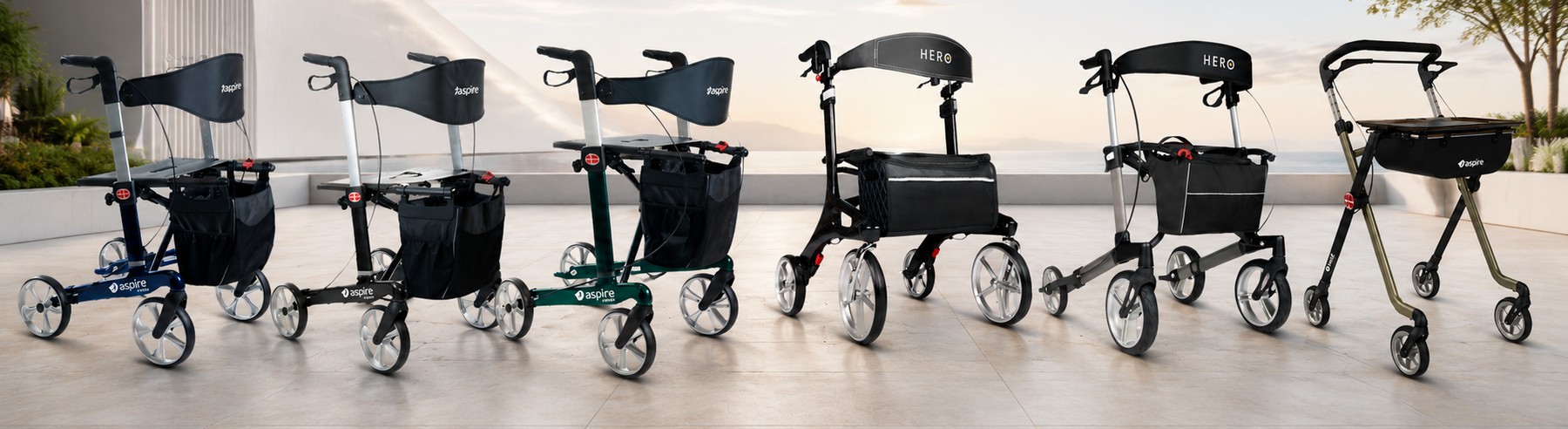
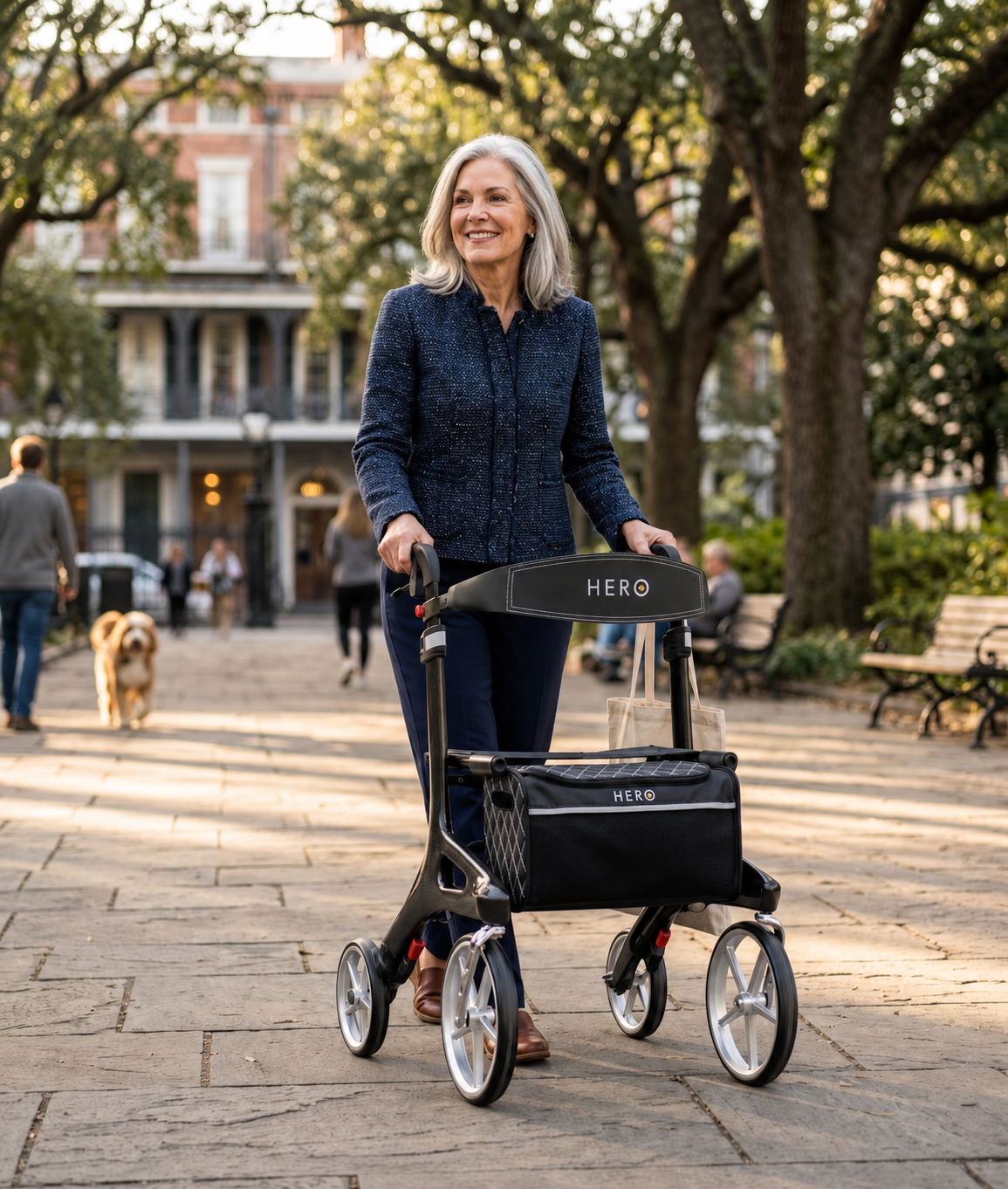
In short: A walker or rollator gives you stability and confidence on your feet. Rollators with wheels, brakes and a seat suit people who walk longer distances and like to rest along the way, while lighter framed walkers suit indoor use and tighter spaces. The main choices are wheel size, weight, whether it folds for the car, and setting the height to you. Funding may apply, and we offer free demonstrations across bayside Melbourne.
Updated August 2026.
A good walker gives you back your confidence. For anyone who has become unsteady on their feet, the right frame or rollator is the difference between staying home and getting on with the day: the shops, the garden, a walk to the corner, an appointment without a fuss. And keeping active is worth even more than the outing itself: a major Cochrane review found that staying active with regular exercise cuts how often older people fall by about 23%, so a walker that keeps you getting out and about is helping you stay active. People search for these as walkers, walking frames, seat walkers or rollators, and they are all part of the same family. This guide explains the differences in plain English, how to choose the one that actually fits, and the models we recommend most often after fitting them at our Cheltenham showroom.
We fit walkers to people every week, and the pattern is always the same: the right choice is not the fanciest one, it is the one that suits how steady you are, how far you want to go, and where you will use it. We stock two brands we trust, Aspire and Hero Medical, so we can match the walker to the person rather than the person to whatever is in the shed. Here is how to get it right.
Find by need
There is no single best walker. The right one depends on how steady you are, how far you go and where you will use it. Here is the fastest way to the one that fits.
The words get used interchangeably, but they are not the same thing, and the difference matters for your safety. It comes down to how much support you need and how you will use it.
A walking frame is the most stable option. It has no wheels, or just two at the front, so you lift or ease it forward and step up to it, taking weight through your arms and the frame. It is made for people who need to lean their weight on something solid, usually indoors and over short distances.
A rollator, also called a seat walker, has four wheels, hand brakes and a built-in seat. It rolls with you rather than being lifted, so it suits people who are steady enough to walk and guide it, but who want the security of something to hold, a seat to rest on and a basket for their things. A rollator is not designed to be leaned on as dead weight the way a frame is; you walk with it and use the brakes to park it before you sit.
If you are not sure which side of that line you are on, that is exactly what a fitting is for. We would rather spend ten minutes helping you judge it in person than have you guess.
Small wheels, around six inches, are nimble and turn tightly, which is ideal indoors and on smooth floors. Larger wheels, around eight to nine inches, roll over cracks, kerbs, gravel and uneven footpaths without catching. If most of your walking is outdoors, size up the wheels; if it is around the house, smaller is easier to steer.
A seat is the whole point of a rollator for many people: the confidence to head out knowing you can stop and sit whenever you need to. Look for a padded or breathable seat at a height that suits you, and a backrest if you will rest for more than a moment. Seat height matters as much as it does on a chair, which is why we set it to the person.
If the walker will travel in a car, its own weight is the thing you will notice most. A standard aluminium rollator is around six to eight kilograms; a carbon fibre frame can come down close to five. Every rollator we recommend folds, most in one movement, so it slides into a boot or tucks beside a chair.
Handles should sit at your wrists when you stand tall with your arms relaxed, so you are not stooping or reaching. The seat should let you sit with your feet flat. A walker that is set wrong makes you lean, and leaning is exactly what we are trying to avoid. Every frame we sell adjusts, several come in low, standard and tall sizes, and we set it for you.
Brakes need to be easy to reach and easy to squeeze. If arthritis or a weak grip is part of the picture, look for soft, loop or palm-style brakes: several of the Aspire rollators use ultra-soft palm brakes with a push-down lock made for exactly this, and the Hero walkers use a light-touch brake with an integrated parking function. Park brakes hold the rollator still before you sit or stand.
A narrow frame fits through doorways and turns in a bathroom; a wider, bigger-wheeled rollator is happier outside. If you need one walker to do both, we will help you find the fair middle, or explain why a light indoor walker plus a sturdier outdoor rollator can be the better answer.
| Type | How it helps | Suits |
|---|---|---|
| Walking frame (no wheels) | Most stable, you lift and place it and take weight through it | Short indoor distances, when you need to lean on it |
| Two-wheel walker | Front wheels glide, rear feet grip the floor | A steadier middle ground, mostly indoors |
| Seat walker / rollator (4 wheels) | Rolls smoothly, hand brakes, a seat to rest and a basket | Getting out and about with confidence |
| Indoor walker | Compact and light, fits doorways, tray option | Room to room at home |
| Heavy-duty rollator | Wider, stronger frame and higher weight rating | Larger users, up to 204kg |
| Knee scooter | Wheels your lower leg while you push with the other | Foot or ankle recovery, non weight-bearing |
Every one of these can be adjusted and tried at our Cheltenham showroom. Pricing is quote based and fitted to you, and funded quotes are usually ready within 24 hours.
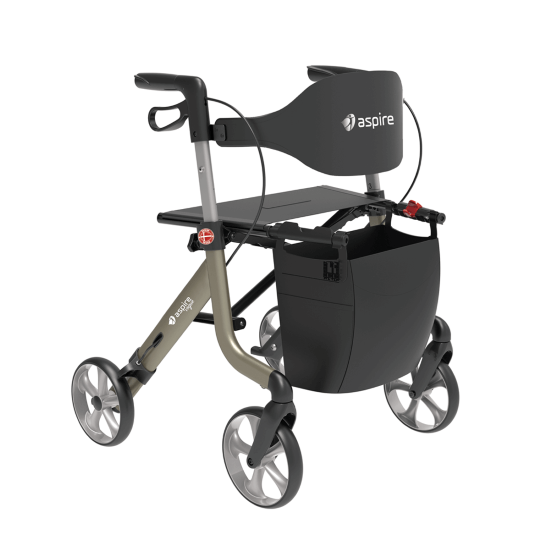
The seat walker we reach for first for most people. The Vogue Light keeps the weight down and the styling clean, so it is easy to push, simple to fold into the boot and pleasant to be seen with, which matters more than people expect: a walker that feels like a lifestyle item gets used, and one that feels like a hospital aid gets left in the hall. Comfortable seat, hand brakes, a basket for the shopping and a 150kg capacity. If you want one good all-rounder and do not want to overthink it, start here.
View the Aspire Vogue Light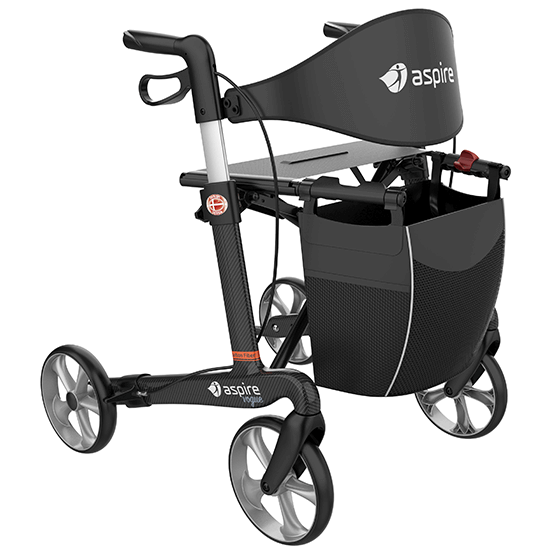
Weight is the thing people underestimate until they are lifting a rollator into a boot twice a day. The Vogue Carbon Fibre uses a carbon frame to bring the weight right down while carrying up to 150kg, and it folds neatly for the car. It also comes in a tall configuration with handles up to 1030mm, so taller people finally get a walker that lets them stand upright instead of hunching over it. Premium, light, and it looks the part. (This is also our best pick for taller users, in its tall size.)
View the Aspire Vogue Carbon Fibre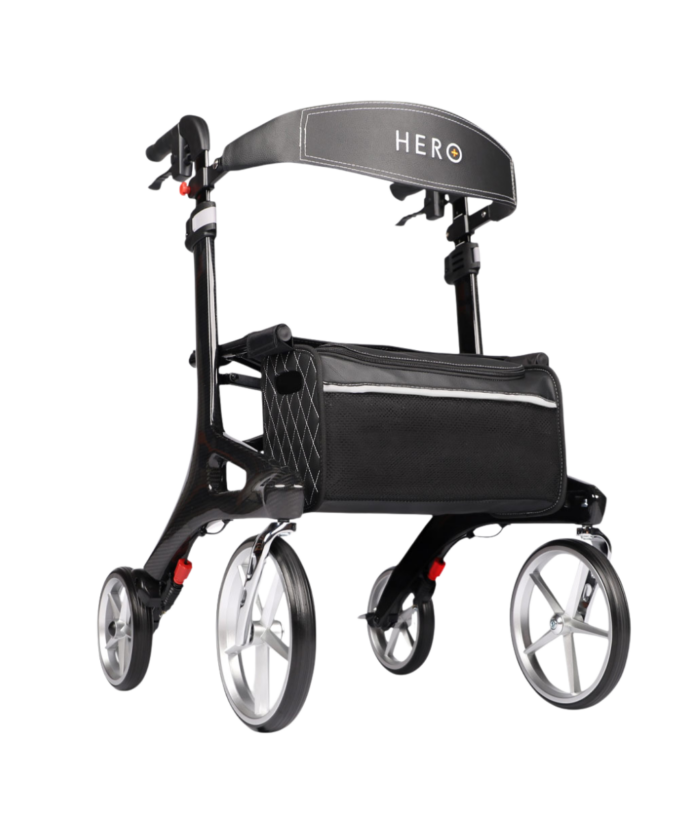
If your walking takes you off smooth footpaths, this is the one to see. The Hero Outdoor Lite pairs large 9.5 inch front castors and shock-absorbing rear wheels with an ultra-light carbon fibre frame, so it rolls confidently over gravel, grass and the cracked paths that catch smaller wheels, without becoming a heavy thing to lift. Light-touch handbrakes with a parking function, a padded seat with an adjustable backrest, a tote bag and a cane holder included. A properly capable outdoor rollator that still fits in the car.
View the Hero Outdoor Lite Carbon Fibre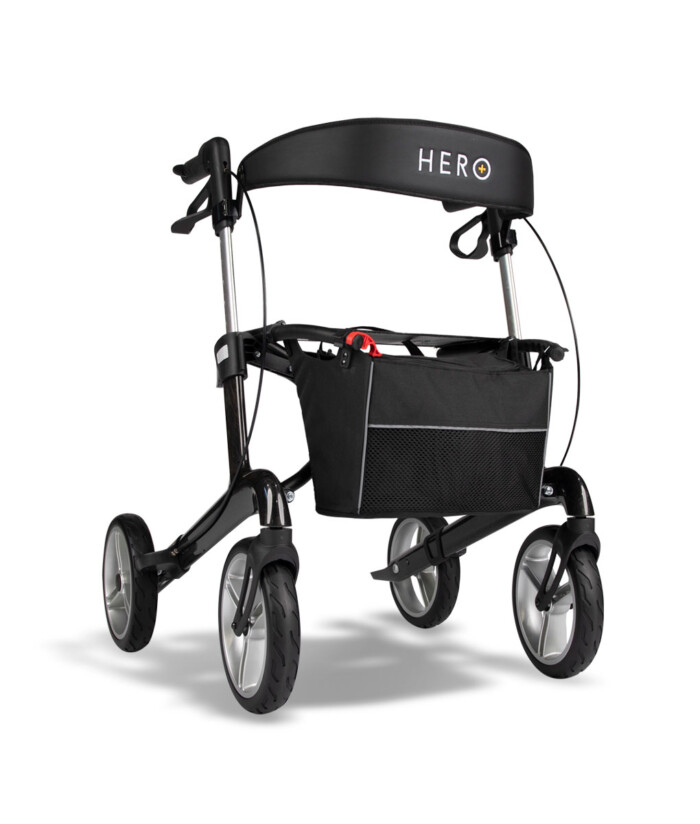
The Euro Lite is the one that makes people do a double take at the price. You get a genuine carbon fibre frame, a breathable mesh seat, a clever seat-lift folding action and a choice of three seat heights so it suits the person rather than the average. Light to push, light to lift, and easy to recommend to anyone who wants a quality walker without stepping up to the dearest frame in the shop.
View the Hero Euro Lite Carbon Fibre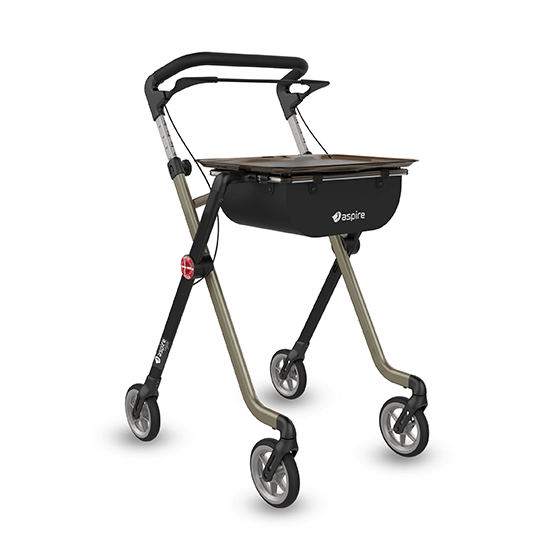
Not every walker needs to conquer footpaths. The Vogue Indoor is made for life inside the house: lightweight, a small turning circle, and slim enough to move room to room and up to the table. For someone who is steady out and about but wants something to hold indoors, or who does most of their walking at home, this is the neat, unobtrusive answer.
View the Aspire Vogue Indoor WalkerQuotes
Pricing is quote based, fitted to you. Funded quotes are usually ready within 24 hours.
Keeping the cost down? The Aspire Classic 8 Seat Walker is a dependable four wheel rollator with larger eight inch wheels, a padded seat and ultra-soft palm brakes, at a sensible price.
Recovering from foot or ankle surgery? A knee scooter rests your lower leg while you push along with the other, keeping weight off a healing foot or ankle.
Need more capacity? Our featured picks are rated to around 150kg. If you need more, the Hero Heavy Duty Outdoor Lite is a heavy-duty seat walker rated to 204kg, in aluminium or a carbon fibre version that carries 204kg while weighing under eight kilograms. Ask us and we will quote the right one.
Just starting out, or unsteady on wheels? If a rolling walker does not feel safe yet, a walking frame is the steadiest thing on the floor because it does not move until you move it. We stock frames with no wheels for maximum grip, two-wheel frames that glide a little more easily, and a stepped frame for extra support when standing up.
A walker is the right tool for a lot of people, but not for everyone, and part of our job is telling you honestly when something else would serve you better. If you find that even a rollator leaves you tired before you have gone as far as you would like, or you are stopping to rest more than you are walking, a mobility scooter may give you back far more range and a lot more of your week. If the hard part of your day is getting up out of the chair, a lift recliner chair does that work for you at the push of a button. And if getting in and out of bed safely is the real worry, an adjustable bed can change that overnight. We fit all three at the same Cheltenham showroom, so it is easy to compare, and we will always point you to the one that genuinely fits, not the dearest one.
Often, yes, and because walkers sit at the lower end of the price range, many people simply buy outright. Where funding applies, we are a registered provider and prepare compliant quotes, usually within 24 hours.
Support at Home (including AT-HM): walkers and rollators can be funded as assistive technology where they are assessed as needed. We prepare quotes in the format your provider needs.
NDIS: participants can fund a walker where it relates to their disability and is reasonable and necessary. We supply full specifications and quotes for planners and OTs.
Buying privately: many clients simply buy outright, with the same fitting, adjustment, delivery and aftercare either way.
Not sure which applies to you? Call 1300 225 203 and we will point you in the right direction, with no obligation.
You cannot judge a walker from a photo. A few minutes with one tells you whether the handles sit right, whether the brakes are easy to squeeze, whether the seat suits you and whether you feel steady. Our Cheltenham showroom at 2/136 Keys Road has the range set up to try, with room to practise turning, stopping and sitting down and standing up. Bring the person who will use it, and we will set every walker to them on the spot. We deliver across metro Victoria, set the walker up, adjust it to the person and make sure they are confident with the brakes before we leave. Walk-ins are welcome weekdays 9am to 5pm, Saturdays by appointment, and there is customer parking on site.
The full range of walkers and rollators is set up to try at our Cheltenham showroom, 2/136 Keys Road, and we will fit and adjust each one to you on the spot. Walk-ins welcome weekdays 9am to 5pm, Saturdays by appointment.
We deliver, install and demonstrate across bayside and Melbourne’s south-east, and you are always welcome at our Cheltenham showroom. See how we help locally in Brighton, Hampton, Sandringham, Beaumaris and Black Rock, or book a showroom visit.
What is the difference between a walker and a rollator?
A walking frame has no wheels, or two at the front, so you lift or ease it forward and take weight through it. It is the most stable option and suits indoor use and people who need to lean on it. A rollator, or seat walker, has four wheels, hand brakes and a seat; it rolls with you and suits people steady enough to guide it who want somewhere to rest. The right one depends on how much support you need, which we can help you judge at a fitting.
Are walkers good for the elderly?
They are one of the most common ways we help older Melburnians stay steady and independent. The right walker takes the wobble out of getting around, gives somewhere to rest on longer outings, and gives families peace of mind about falls. The national health service healthdirect puts it plainly, that walking aids give you extra support to help keep your balance and walk more easily. We match the walker to the person and set it to them.
What is a seat walker?
A seat walker is another name for a four wheel rollator: a walking aid with wheels, hand brakes and a built-in padded seat, so you can walk with support and sit down to rest whenever you need to. Most also have a basket or bag for shopping and belongings.
How do I choose the right size walker?
Handle height is the main one: the handles should sit at your wrists when you stand tall with your arms relaxed, so you are not stooping or reaching. Seat height should let you sit with your feet flat. Taller people are better on a tall frame like the Aspire Vogue Carbon Fibre in its tall size, and shorter people on a scaled-down frame like the Aspire Mini. We set all of this at the fitting.
How much does a walker or rollator cost in Melbourne?
As a guide, simple walking frames start around $120, quality four wheel seat walkers generally land between about $250 and $700, and premium carbon fibre and heavy-duty models reach around $1,500. We quote each one fitted to the person, including adjustment, delivery and aftercare, and funded quotes are usually ready within 24 hours.
What is the lightest walker you have?
Our lightest frames are the carbon fibre models: the Aspire Vogue Carbon Fibre and the Hero Euro Lite and Outdoor Lite carbon walkers. All keep the seat, backrest and brakes while being genuinely easy to lift into a car boot.
Can I get a walker for a heavier person?
Yes. Most rollators are rated to around 150kg, and for higher weights the Hero Heavy Duty Outdoor Lite is a purpose-built heavy-duty seat walker rated to 204kg, in aluminium or carbon fibre. Choosing a walker rated above the person’s weight matters for safety, so tell us the weight and we will match it properly.
Is it safe to lean on a rollator to stand up?
Not as a rule, because a rollator is on wheels and can roll away. Always put the park brakes on first, then use it to steady yourself. If you need to take real weight through a frame to stand, a walking frame or a stepped frame is the safer tool, and we can show you the difference at the showroom.
What is a knee scooter?
A knee scooter, or knee walker, rests your lower leg on a padded platform and rolls on wheels, so you can keep weight off a healing foot or ankle while you push along with your good leg. It is a short-term aid that makes recovery from foot or ankle surgery far easier than crutches for many people.
Will the NDIS or Support at Home pay for a walker?
Both can, where the walker is assessed as needed. We are a registered provider and prepare compliant quotes, usually within 24 hours, in the format your planner, provider or OT needs.
Do you deliver and set up?
Yes, across metro Victoria. We deliver, adjust the walker to the person, check the brakes and make sure they are confident before we leave. You can also come and try the range at our Cheltenham showroom.
Match the type to how steady you are and where you will walk: a frame for maximum stability, a rollator for getting out with a seat to rest, a light or carbon frame if you lift it into a car, and a tall or heavy-duty frame if a standard one does not fit. Then set it to the person and try it before you decide. Visit us at 2/136 Keys Road, Cheltenham, or call 1300 225 203 and we will help you get it right the first time.
Thinking further ahead, or covering more than one need? Read our guide to the best mobility scooters in Melbourne, the best lift recliner chairs in Melbourne, and the best adjustable beds in Melbourne.

Daylan Kempster co-owns and runs Mobility Co, a locally owned assistive technology showroom in bayside Cheltenham. The team works alongside occupational therapists and families across Melbourne to match people with lift recliner chairs, adjustable beds, mobility scooters and walkers that suit real homes rather than clinical settings. Mobility Co is a registered NDIS provider. Visit the showroom at 2/136 Keys Road, Cheltenham, or call 1300 225 203.
The right walker or rollator matters after a stroke and when recovering from hip or knee surgery. For heavier or larger builds, see our guide to mobility equipment for larger or heavier people. If distance is the real challenge, compare our best mobility scooters. To understand how to pay for equipment, read our mobility equipment funding guide.
Daylan Kempster is an assistive technology specialist and the director of Mobility Co, a family owned mobility equipment showroom in Cheltenham, Melbourne. He has close to ten years of experience in the assistive technology and healthcare sector, gained across several companies, working with older Australians managing the changes of ageing, younger people living with disability, and people who need the right equipment for a short time while they recover from surgery. He writes these guides from hands on experience helping families choose beds, chairs, scooters and walkers that suit a real home. Connect with Daylan on LinkedIn.